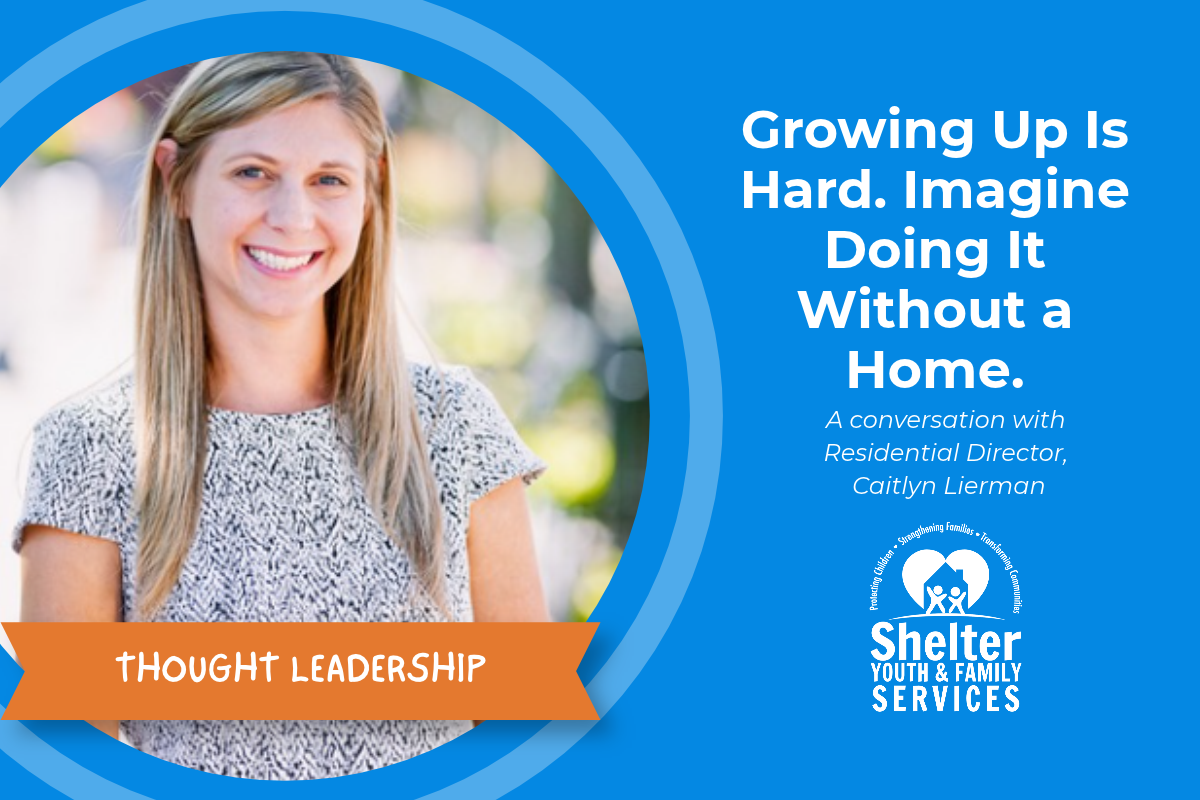
Why young people experiencing homelessness need more than a place to live.
By Caitlyn Lierman, MSW, LSW
Residential Director
Shelter Youth & Family Services
Think about the young adults you know. How many have never made their own doctor’s appointment? How many need reminders to show up on time, help preparing for an interview or a parent to walk them through something unfamiliar?
These are ordinary parts of growing up. Most young adults are still figuring things out. Most have someone they can turn to for help.
Now imagine doing all of that while worrying about where you’re going to sleep.
That’s something I wish more people understood about youth homelessness. The young people we work with aren’t just facing housing instability. They’re learning to become adults, often without the support many of us take for granted.
Growing up takes time
There’s a developmental reason for this. According to the National Institute of Mental Health, the prefrontal cortex, which helps with planning and decision-making, continues to mature into young adulthood.
Young people are still building skills through experience. Yet an 18-year-old without stable housing may suddenly be responsible for finding a place to live, earning money, managing health care and getting to work.
That’s a lot to navigate without guidance.
Sometimes the help is simple
One thing I’ve learned overseeing Shelter’s residential services is that young people don’t always need someone to tell them what to do. Sometimes they just need someone beside them while they do it.
I’ve had young people ask a case manager to sit with them while they call a doctor’s office. Others want someone to accompany them to a job fair or wait outside during an interview.
They know what they need. They’ve just never done it alone.
Our job is to help them build that confidence.
It’s not always easy. Sometimes a young person misses an appointment or doesn’t follow through. We still have expectations. But we also understand that learning independence takes practice, patience and occasionally a second chance.
Housing is the foundation
At Shelter, our youth housing program provides eligible young adults ages 18 to 24 with rent- and utility-free housing for up to 24 months, along with individualized case management.
We have six residential apartment spaces, and they’re almost always full.
Housing is the foundation, not the finish line.
Once young people have a safe place to live, we can work with them on education, employment, mental health care and the practical skills they need to live independently.
Over time, the conversations change. Young people begin talking about careers, college, driver’s licenses and finding apartments of their own.
These are ordinary goals. But they’re much harder to pursue when you don’t know where you’ll sleep.
Awareness creates opportunities to help
November is Youth HOPE Month, focused on homelessness outreach, prevention and education.
Youth homelessness often goes unnoticed, particularly in suburban communities. A young person might be staying on a friend’s couch, living in a car or moving between temporary arrangements while still attending school or working.
And the warning signs aren’t always obvious. Trouble getting to school, keeping a job or meeting responsibilities may reflect circumstances we know nothing about.
Before making assumptions, we should ask questions.
Recently, a young woman living in her car reached out to Shelter. She was a certified nursing assistant who needed scrubs and gas to get to work.
We helped her get both.
She wasn’t asking someone to figure out her future. She just needed a little help getting to work.
That’s often what support looks like.
During Youth HOPE Month, I hope more people recognize that young people experiencing homelessness face two challenges at once: finding stability and learning how to be adults.
They need housing. They also need guidance, patience and the chance to make mistakes and learn from them.
Most of us had someone to help us do that.
If you are a young person experiencing housing instability, or know someone who needs support, contact Shelter Youth & Family Services at yeh@shelter-inc.org.